
The best choice depends on your shellfish, available space and customers
At Todd Fish Tech we manufacture two different types of live crustacean holding system. The Lobster Pod is a vertical stacking system while the Crab Pod is a more traditional tank-based system. Both have their advantages and choosing between them really comes down to the species you’re holding, how much space you have and how you sell your shellfish.
What are the advantages of a Lobster Pod?
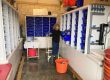
The Lobster Pod uses customised fish boxes stacked one above the other to make the best use of available floor space. Our largest standard Lobster Pod holds up to 300kg of shellfish in just 3.2m² which makes it particularly useful for fishermen and fish merchants working in smaller premises.
It’s also energy efficient. A single recirculation pump takes the seawater to the top of the system and gravity does the rest as the water flows down through the trays.
One of my favourite features is that you can hold different species in separate trays within the same system. This means you can have lobsters, crabs and langoustines in one Lobster Pod provided the water conditions are suitable for them all. It’s particularly handy if you’re catching several species or selling to different customers.
What happens to a Lobster Pod during a power cut?
The Lobster Pod has a useful feature for dealing with power interruptions. If the electricity goes off the seawater automatically drains from the trays into the sump tank. When power is restored the pump is designed to self-prime and the water starts circulating again.
This provides a degree of protection during a power cut because the shellfish are held damp in their individual trays rather than relying on a tank remaining aerated. Of course it’s still important to monitor your system and deal with prolonged power interruptions.
Does a Lobster Pod use less water?
Yes. Because the shellfish are held in stacked trays rather than a large tank the Lobster Pod operates with a relatively small volume of seawater.
This makes a difference when you’re filling the system for the first time and when carrying out water changes. On our largest standard Lobster Pod a 20% water change is approximately 300 to 400 litres depending on the system configuration.
For fishermen who have to collect seawater or prepare artificial seawater this can be a considerable practical advantage.
What are the advantages of a Crab Pod?
The Crab Pod is our tank-based holding system and will be more familiar to anyone who’s used traditional lobster or crab tanks.
One of its biggest advantages is how easy it is to see your shellfish. With the Lobster Pod you need to look into the individual trays and if you’re my height you might need a step to reach the top ones! With the Crab Pod you can look across the tank and check your stock much more quickly.
This can be particularly useful if you’re holding a large quantity of one species and selling everything to one customer. For example if a vivier lorry collects your shellfish at the end of the week the tank-based arrangement can make loading and unloading more straightforward.
How much space does a Crab Pod need?
A standard Crab Pod is approximately 5 metres long and 2 metres wide giving it a footprint of around 10m². This system can hold up to 750kg of shellfish.
We can also manufacture smaller bespoke Crab Pods to suit the space available. However a tank-based system generally requires more floor space per kilogram of shellfish than the vertical Lobster Pod.
If you’re short of space the Lobster Pod is usually the better option. If you have plenty of room and need a larger holding capacity the Crab Pod may be more suitable.
Does the larger water volume make a difference?
One advantage of the Crab Pod is its larger volume of seawater. This helps dilute waste produced by the shellfish and can reduce the speed at which water quality changes.
For example a larger volume of water can help buffer changes in ammonia concentration, salinity and pH. This doesn’t remove the need for good filtration or regular water testing but it can make the system more forgiving when conditions change.
The trade-off is that water changes involve a greater volume of seawater. If you’re based beside the sea with easy access to replacement water that may not be much of a concern.
Is the Crab Pod easier to operate?
For someone who’s already familiar with conventional shellfish tanks the Crab Pod may feel more straightforward. There’s less pipework and fewer valves to become familiar with compared with the Lobster Pod.
Both systems have integrated filtration including mechanical filtration, biological filtration, UV treatment and a protein skimmer. The Crab Pod also has integrated air and water channels which are designed to distribute circulation and aeration through the tank.
Neither system is particularly complicated once you understand how it works but the Crab Pod offers a more familiar arrangement for operators who prefer a traditional tank.
Which system is better for fishermen and fish merchants?
If you’re catching several species, grading shellfish or supplying different customers I’d usually recommend the Lobster Pod. The individual trays make it easier to separate and organise stock while the vertical design saves valuable floor space.
If you’re holding large quantities of one species and supplying one main customer the Crab Pod may be the better choice. It’s easy to inspect and unload and the larger water volume offers some advantages for managing water quality.
The Crab Pod can also work out more cost effective per kilogram of holding capacity when you have the space and the water supply to accommodate it.
Lobster Pod or Crab Pod: Which would I choose?
Neither is automatically better than the other. They were designed for different ways of working and both have their place in the fishing industry.
The questions I’d ask are how much shellfish you need to hold, whether you’re dealing with one species or several, how much floor space you have and how your customers collect their stock.
Once we know those things it’s usually fairly easy to work out which system will suit your business.
You can find out more about our Lobster Pod holding systems or get in touch with Keith or Errin at Todd Fish Tech to discuss your requirements.
Last Updated November 2026