
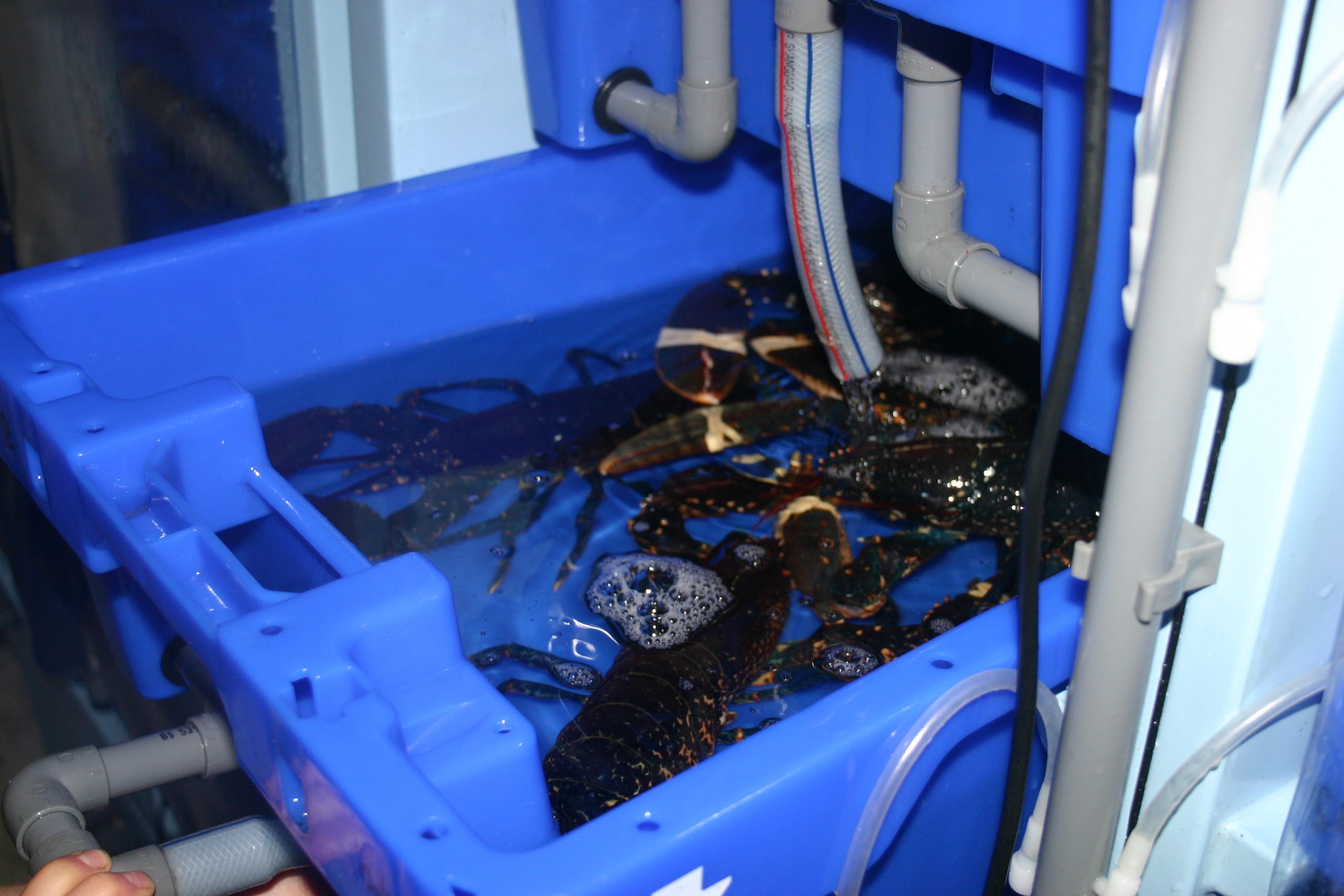
Every lobster holding system has a maximum shellfish capacity.
The filtration is designed to handle the waste produced by that quantity of stock. If you put more lobsters into the tank than it is rated to hold the filtration can become overloaded. This can quickly lead to dirty water, high ammonia, falling pH and stressed lobsters.
Why does the capacity of a lobster tank matter?
The filtration on a lobster tank should be designed around the amount of shellfish it is expected to hold. A system rated to hold 100kg of lobster needs enough mechanical and biological filtration to deal with the waste produced by 100kg of stock.
Adding more lobsters doesn’t increase the capacity of the filtration. It simply gives the filters more waste to deal with.
This is why we give every Todd Fish Tech shellfish holding system a recommended maximum capacity. Staying within that capacity is an important part of maintaining good water quality and protecting your stock.
What happens to the mechanical filtration if you overload a lobster tank?
The mechanical filters remove physical waste such as sand, silt, faeces and dirt from the water.
If there are too many lobsters in the tank the mechanical filtration may struggle to remove this waste quickly enough. The water becomes dirtier and the overall conditions in the tank deteriorate.
Lobsters held in poor water conditions become more stressed. This is particularly important when you’re holding valuable live stock and trying to keep it in the best possible condition.
Why does ammonia rise in an overloaded lobster tank?
The biological filter deals with the ammonia produced by the lobsters. Nitrifying bacteria convert ammonia to nitrite and then nitrate.
The biological filter has a limit to how much waste it can process. Put too many lobsters into the system and you can produce ammonia faster than the bacteria can deal with it.
The result is rising ammonia.
This can then create a vicious circle. High ammonia levels stress the lobsters. Stressed lobsters can produce more ammonia which puts even more pressure on an already overloaded biological filter.
Eventually ammonia can reach dangerous levels and the survival of your stock is at risk.
Why does overloading a lobster tank lower the pH?
Every lobster in the tank uses oxygen and produces carbon dioxide. Increasing the quantity of lobsters increases the amount of carbon dioxide being produced.
As carbon dioxide builds up the pH of the seawater can fall and become more acidic.
Low pH isn’t only a problem for the lobsters. It can also affect the nitrifying bacteria inside the biological filter. This means that just when you need the biological filtration to work harder it may actually become less effective.
For lobster holding we aim to maintain the pH at around 8.0–8.2. A significant drop below the correct operating range can affect the condition and survival of the stock.
Why is overloading particularly dangerous during filter maturation?
Overloading is an even bigger problem during the initial maturation of a new lobster holding system.
The biological filter needs time to develop a healthy population of nitrifying bacteria. During this period the quantity of lobsters in the system should be increased gradually.
If too many lobsters are added too quickly the resulting high ammonia and low pH can prevent the biological filter from developing properly. Instead of reaching full capacity more quickly you’ve actually slowed the maturation process down.
It is completely counterproductive.
The best approach is to start with a small quantity of healthy lobsters. Test the water regularly and only increase the stock when the water parameters are at optimum levels. This allows the biological filtration to develop alongside the increasing biological load.
What should I do if I’ve overloaded my lobster tank?
If you’ve accidentally overloaded your system then water quality needs to be monitored very closely.
Test ammonia, nitrite and pH regularly. If ammonia starts rising or the pH begins to fall you will need to act. Large water changes may be necessary to reduce ammonia and help maintain the pH at around 8.0–8.2.
You should also reduce the quantity of lobsters in the tank as soon as you can. A water change can help deal with the immediate water quality problem but it doesn’t increase the capacity of the filtration.
If the tank remains overloaded the problem is likely to return.
More lobsters in the tank doesn’t mean more lobsters to sell
We understand why overloading happens. The season is at its peak. You’ve caught or bought more lobsters than expected and there is an empty-looking space in the tank.
It can be very tempting to squeeze a few more in.
Don’t.
We’ve been designing and manufacturing shellfish holding systems since 1998 and we’ve seen the consequences of overloaded systems. The capacity isn’t an arbitrary number. It reflects the amount of stock the filtration has been designed to support.
Overload the tank and you risk dirty water, high ammonia, falling pH and stressed stock.
Trust us. You’ll pay for it in lost lobsters if you do.